
Waste brokers often feel confused when comparing DSQ Discovery and cieTrade. Until now, there wasn’t a good comparison of these two software options.
Part of the confusion is because these platforms were built for two completely different purposes.
When evaluating waste brokerage software, the most important question is “what was the software was originally built to do?” Feature comparisons come later.
cieTrade was built primarily for commodity traders and recyclers. DSQ Discovery was built specifically for waste brokers and waste program managers.
That distinct difference in purpose drives the design of each platform.
We created this comparison to help highlight the relative strengths of these two software products. Hopefully it helps you as you seek to decide which might be best for your unique needs.
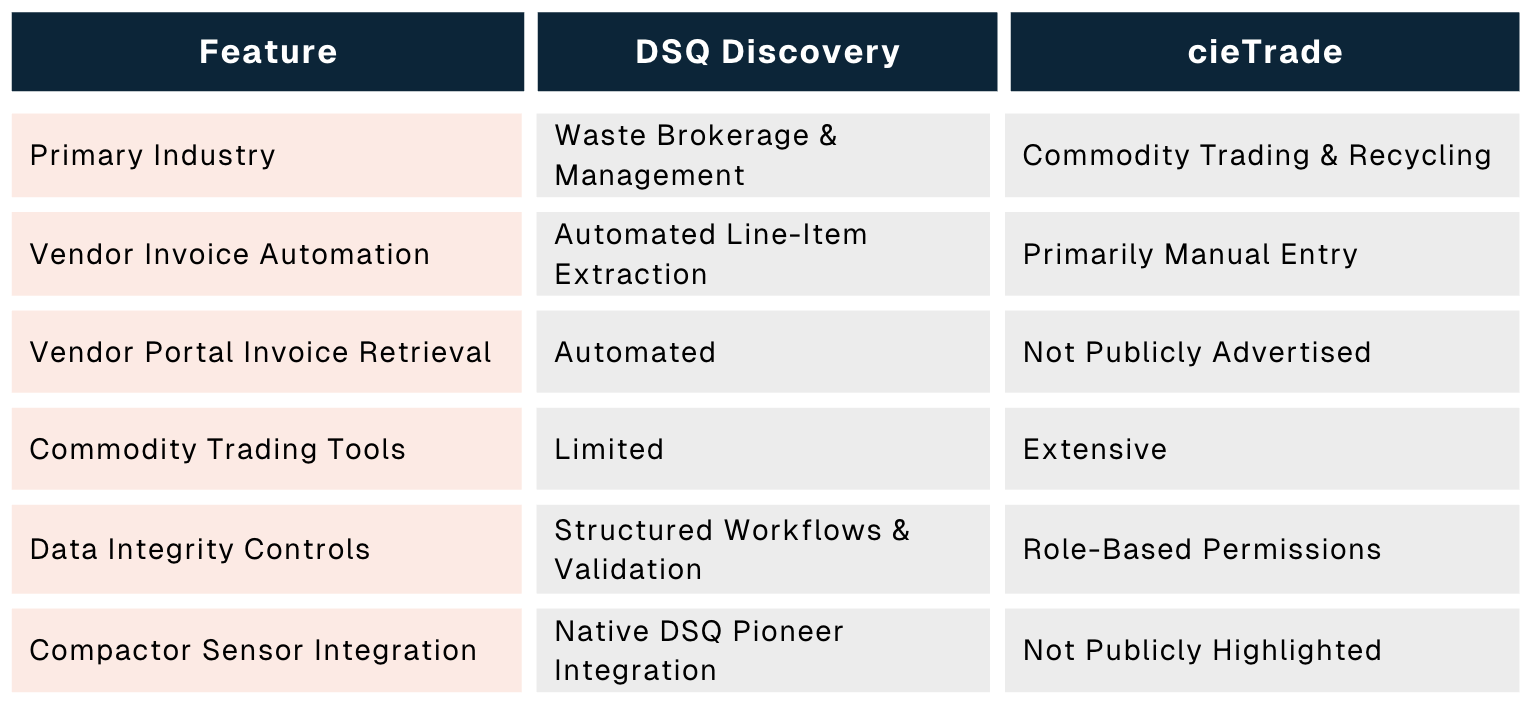
DSQ Discovery vs cieTrade: Quick Comparison
Who Should Use DSQ Discovery
DSQ Discovery is typically the better fit for:
- Waste brokerages processing & auditing vendor invoices
- Companies managing waste service contracts
- Waste program managers needing invoice auditing
- Teams that want automated vendor portal retrieval and invoice extraction
- Companies that want an integrated connection of compactor monitoring and invoice auditing.
Who Should Use cieTrade
cieTrade may be the better fit for:
- Commodity trading houses
- Recycling material brokers
- Companies managing buy/sell commodity trades
- Businesses requiring commodity pricing formulas and settlement tracking
Let's dig into some details.
Waste Invoice Automation Software Options
About DSQ Discovery
DSQ Discovery is purpose‑built waste brokerage software offering full operational control and visibility for waste brokers and program managers. DSQ Discovery was originally built to run Sequoia Waste Solutions (sold 2022). DSQ has more than a decade of firsthand experience with invoice complexity, vendor portals, and the unique challenges faced by waste brokers.
DSQ Discovery supports organizations of all sizes, from single‑operator brokerages to large enterprise teams and even waste haulers. Smaller operators benefit from built‑in workflows that enforce consistent processes, while larger brokers rely on DSQ’s accuracy, reliability, and fully documented API to match their scale. Because DSQ actively learns from a wide range of customers, the platform continues to evolve with the industry and adapt to emerging needs.
About cieTrade
cieTrade is a leading software provider for the recycling and commodity trading industries, which also offers a waste brokerage module. Their platform manages operations end-to-end—logistics, inventory, documentation, billing, and accounting—all from one central system. You can deploy it in the cloud or on-premise, and it's used by recyclers, trading houses, and commodity brokers around the world.
DSQ Discovery vs cieTrade for Waste Brokerages
So what’s the real difference?
CieTrade is built primarily for commodity brokers and recyclers.
DSQ Discovery is built for waste brokers and managers.
All differences in the user experience and feature set are a result of that foundational difference in purpose.
Both platforms aim to streamline operations, but they take fundamentally different approaches—especially when it comes to vendor invoice processing and overall automation.
cieTrade is built for operational workflows in commodity trading, and its billing functionality operates within its broader commodity trading structure.
DSQ Discovery’s vendor invoice automation is purpose-built for waste brokerages to speed their AP cycle while increasing accuracy and includes the ability to send out Customer invoices natively from DSQ Discovery, with accounting hook-ins to keep your accounting systems up-to-date.
Accurate AP & AR in waste brokerage. That’s DSQ Discovery!
Summary: Different user experience because of a different fundamental purpose.
1. Automation vs Manual Data Entry
The fundamental differences in purpose between DSQ Discovery and cieTrade is on display when vendor invoice data needs to be extracted at the line item level.
cieTrade doesn’t advertise automated vendor‑portal invoice retrieval or line‑item extraction, so users often rely on manual data entry. This slows processing and increases the risk of errors. Because cieTrade depends on user‑driven entry without strict formatting controls, the same data—like container size—may be entered inconsistently (e.g., “8CY,” “8‑yd,” “8yard”), causing reporting issues later. In contrast, DSQ Discovery builds structured validation and standardized formatting directly into its workflow.
This manual data entry approach can result in invoice process workflows that can be twice as long as using DSQ Discovery.
Alternatively, with DSQ Discovery the entire invoice process begins with automated line-item level extraction on every invoice. This helps to make it so that your invoice process can be completed in half the time, with fewer people involved in the process. The benefit of this higher level of automation and accuracy is that it allows your team to spend more time on higher value tasks and to bill revenue faster and more accurately.
DSQ Discovery has features that cieTrade doesn’t offer:
- Automated Invoice Gathering: DSQ’s “Rovers” retrieve vendor invoices the same day they're published on vendor portals
- Line-Item Data Extraction: Full extraction and categorization of waste-specific data (extra charges, minimum tonnage, roll-off, fuel/energy, allocatable fees, etc.)
- Automated Invoice Auditing: Invoices are automatically compared against your waste contracts to flag discrepancies
cieTrade relies more heavily on user manual data entry and process discipline, whereas DSQ builds structured formatting and validation into the workflow.
2. Commodity Trading & Tracking
One place where cieTrade shines, and DSQ Discovery doesn’t have a truly comparable offering, is Commodity Trading & Tracking.
This is what we understand about it:
- Unified Buy/Sell Trading Form
cieTrade centers its trading logic around a “buy/sell” trade form that organizes all financial and logistical data for a commodity shipment (including weights, pricing, documents, emails and related files) in a single “virtual file folder.” This makes it easy to track each trade from initial order through settlement.
- Flexible Pricing & Orders
- Supports spot and contract orders with pricing by account, grade, weight, packaging, per-each and more.
- Includes market/index formula pricing and differential pricing, with automatic price roll-overs and a “confirmed pricing” workflow to avoid settlements on unconfirmed prices.
- Maintains pricing history and real-time status in a central dashboard.
- Logistics & Shipment Tracking
cieTrade tracks logistics and shipment status tied to each commodity trade — including open orders, in-process shipments, approvals, carrier details, bills of lading, and more. These details are searchable by a wide range of references (order number, truck, invoice).
- Document & Email Management
The system can automatically generate specialized shipping and billing documentation (packing lists, bills of lading, commercial invoices) using customizable templates and digital signatures. It also captures and attaches related emails and external documents directly from Outlook.
- Gross Profit & Commission Reporting
cieTrade calculates projected profitability per trade by matching expense accruals with revenue. It can report gross profit by customer, supplier, product, sales rep, and more, and generate commissions based on configurable formulas.
- Visibility & Business Intelligence
The platform provides real-time reporting on pricing trends, tonnage, order fulfillment, budget vs. actuals, settlement statements, and more — helping users spot trends and make decisions faster.
If you’re in the business of commodity brokerage and managing recycling materials, this is where cieTrade shines.
DSQ Discovery does offer a robust rebate management system, but again, that is not the same purpose as what cieTrade offers for commodity brokerage.
3. Data Integrity
To our knowledge, there is a meaningful difference in how each system prevents data errors and maintains data integrity.
cieTrade appears to rely primarily on role-based permissions and user controls to manage data changes. This approach usually means users need to create extensive, detailed manual processes and controls to prevent mistakes. It can work in a highly trained, highly skilled team.
DSQ Discovery takes a fundamentally different approach. DSQ’s data integrity approach is built directly into our field level controls and our automation:
- Fields require data to be formatted properly, or are pick lists, to prevent data creativity. Automated workflows include validation at each step of the process.
- DSQ Discovery guides users through the right process, preventing errors before they happen.
4. Integrated Sensor Management
Both DSQ Discovery and cieTrade can work with compactor monitors, but there's a significant difference in how that integration functions.
DSQ Discovery offers sensor integration and management with DSQ Pioneer compactor monitors. You can see DSQ Pioneer compactor monitor fullness readings directly in the platform, set service thresholds for individual compactors (example: pull at 80%, pull at 85%, on-call vs scheduled), and actively manage your monitoring program—all within DSQ Discovery.
Learn more about how integrating DSQ Pioneer compactor monitors saves thousands in waste invoices annually.
cieTrade does not publicly highlight embedded compactor threshold management comparable to DSQ Discovery’s integrated sensor workflow. This would mean the data doesn't flow into cieTrade in a way that allows for automated management. Instead, users must manage distinct work flows between two unique systems when using cieTrade.
Can You Use DSQ Discovery and ceiTrade Together?
While it's technically possible to use both systems in complementary fashion, we haven’t yet seen anyone do this. If you’re considering it, let’s talk!
Looking for a cieTrade Alternative?
Waste brokerages often evaluate DSQ Discovery as an alternative to cieTrade when they need:
- automated vendor invoice processing
- contract-level invoice auditing
- waste-specific charge categorization
- vendor portal invoice retrieval
- structured data controls
For organizations whose operations are primarily waste brokerage rather than commodity trading, DSQ Discovery may provide a better operational fit.
Both platforms are powerful — but they were built for different industries.
- cieTrade excels in commodity trading and recycling brokerage.
- DSQ Discovery focuses on waste brokerage operations and vendor invoice automation.
Understanding that difference in purpose helps determine which platform best supports your business.
The DSQ Discovery Experience
Don't take our word for it. One of our DSQ Discovery customers, a Managing Partner at a Waste Brokerage, said it best:
"DSQ Discovery stood out to us because it was developed by brokers, so I know it is made for the applications we need." Read his full testimonial here.
DSQ Discovery was built by people who lived the manual invoice processing nightmare. We built it to solve our own pain points when we ran Sequoia Waste Solutions. That real-world experience is embedded in every feature, every workflow, every automation.
cieTrade is great for commodity brokerage and offers contract storage and customer invoice generation. It differs in not having true vendor invoice processing automation, automated line-item extraction, and built-in data integrity controls. The result is that you're still doing most of the work manually.
There’s a difference. Pick the one that is best for your business!
See how the DSQ Discovery system works: watch our demo here.